German Wine Laws 2026: What the New Rules Mean for the 2026 Vintage
With this blog I’ll be taking a dive into the confusing, slightly over convoluted system of German wine classifications and what is changing from the 2026 vintage onwards. The current law dates back to 1971, with the new revision introduced in 2021 finishing its transition in time for the 2026 harvest.
The idea is to bring German wine labelling and laws in line with the majority of the world that consumers can understand, marking quality out by geographical indication rather than their Prädikatswein levels.The Deutscher Weinbauverband (DWV), the German Winegrowers' Association, has been heavily involved in shaping and implementing the new system. For one of the more premium quality matters, the DWV and the Verband Deutscher Prädikatsweingüter (VDP), Germany's best known quality-driven independent wine body, were formally brought together in establishing the selection criteria and framework for Erste Lage and Grosse Lage/Grosses Gewächs classifications. More on those later.
But first, you must understand the laws as they were before 2026.
The 1971 German Wine Laws
Any German wine lovers will be somewhat aware of the various label indicators already. I’d be brief if I could, but there’s rather a lot to cover to help you understand.
Sweetness
An important part of German wine identifty, sweetness has the following categories:
- Trocken – dry
- Halbtrocken/Feinherb - off-dry
- Lieblich - medium/medium-sweet
- Süss – sweet
Quality
Quality indicators are the main changes for the 2026 regulations. This is how they were categorised beforehand:
- Deutscher Wein – The most broad category for wine with no regional bearing except anywhere in Germany
- Landwein – the most broad regional category
- Qualitätswein – Wine from one of 13 designated wine regions that undergoes a blind taste test prior to release
- Prädikatswein – The best pre 2026. A more distinct Qualitätswein from one of 40 districts within the 13 regions that is commonly associated with Riesling but is open to any grape variety. There are 6 levels within this, in increasing order of must weight: Kabinett, Spätlese, Auslese, Beerenauslese, Eiswein and Trockenbeerenauslese
These 6 levels are linked as quality indicators, regardless of whether they came from a great vineyard or an average one. This is one of the key things that the revision seeks to change.
There’s already a lot to unpack in these, which you can learn more about on our German Wine page but it gets even more complex as geographical labelling comes into play. There are districts (Bereiche), single vineyards (Einzellagen) and collective vineyard sites (Grosslagen) to consider. This is exacerbated when some well-known estates don’t need to precede the Einzellage or Grosslage with the village name, resulting in wines like Piesporter Goldtröpfchen and Piesporter Michelsberg sounding like they should be the same quality. The former is a high-quality Einzellage making exceptional Mosel Riesling, the latter inexpensive, lower quality. Price is a good indicator of course, but the naming doesn’t inspire consumer confidence.
The German wine scene is also historically mired thanks to Liebfraumilch in the 1980s, popular at the time, but now leaving a legacy of cheap, sweet, bad wine for those who experienced its heyday.
Finally, due to the issues around the Einzellage and Grosslage system, German producers have taken it upon themselves to establish associations with their own stricter rules and classifications, as a way of marking quality more clearly. The best known is the VDP, with over 200 members. Their symbol is the eagle with a bunch of grapes, a familiar symbol on many exported German wines. They have also established their own classification system. From 2012 the rules are:
- VDP Gutswein - regional wines which must come from a member’s own estate.
- VDP Ortswein - Village wines, much like you’ll find in Burgundy.
- VDP Erste Lage - Similar to Premier Cru, these are ‘first-class’ vineyards worthy of distinction.
- VDP Grosse Lage - Similar to Grand Cru, these are the very best parcels and vineyards. They use the term Grosses Gewächs which appears as a simple GG trademark on the label.
We aren’t quite there yet…
The Rheingau Charta is a separate entity to consider, founded in 1984 for the dry whites of the best vineyards in the Rheingau region, which use the term Erstes Gewächs and must be either Riesling or Spätburgunder (Pinot Noir). Members of the VDP in the Rheingau can use Grosses Gewächs for these.
That sums up German wine law up to this point, which will be important for understanding with the new laws on the way.
The 2026 Changes
The need is to make German wine simpler to understand, to boost success in export markets and help consumers understand what the wine in the bottle might actually be like. It aims to align German wine law more closely with EU wine law, giving consumers a recognisable base to start on.
The importance of origin
The idea is that quality will be more recognised based on how precise the area the wine came from is, rather than must weight of the 6 Prädikatswein distinctions, on which consumers previously were taught to base quality off. They still exist, but now as style indicators rather than quality as well.
The overall categories are the same. Deutscher Wein is still the basic non-geographical designation. Landwein will become PGIs (Protected Geographical Indication), an EU term where at least 85% of the grapes must come from the region which must appear on the label. A bit like Vin de Pays or Toscana IGT.
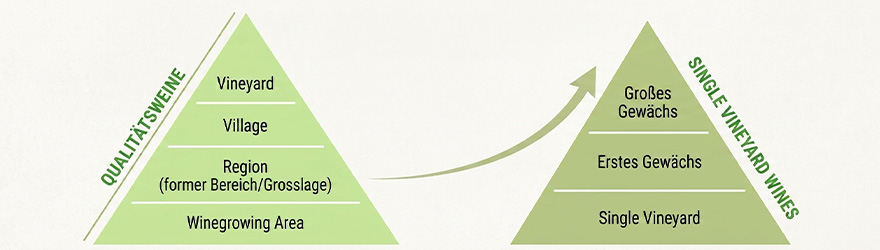
For Qualitätswein, they have created a new geographical quality pyramid to reflect this going up from winegrowing area-region-village-single vineyard.
The winegrowing area (Anbaugebiet) is the broadest, and is much the same, with 13 regions designated. The region replaces the former Bereiche and Grosslage terminology, avoiding issues like the Piesporter Goldtröpfchen and Piesporter Michelsberg example. The village (Ortswein) takes on some of the success found with the VDP and means wines must have the village name on the label. And finally, the single vineyard (Einzellage) can range from dry to sweet. To remind you, Prädikatswein fits within these still, just importantly not as quality indicators.
Within the Einzellage, there are two further designations. Erstes Gewächs (first growth) and Grosses Gewächs (great growth) which you will recognise from the VDP and Rheingau Charta. Gewann has also been introduced as a form of lieu-dits, where producers can have individual parcels of a vineyard recognised for quality too.
Each wine growing region now has something known as a Schutzgemeinschaften, whose role is to represent growers and producers in each region with the ability to add additional qualifications beyond the guidelines in national law. They also designate allowed varieties and manage the tasting board for Qualitätsweins.
There is a fair argument to say that the non-VDP members may benefit from extending the use of classifications such as Erste Lage and Grosses Gewächs. The Schutzgemeinschaften are unlikely to be able to keep up the same standards as they will have many more producers to deal with, so there is some quality dilution expectation. They won’t be as rigorous in crafting quality based rules, and bureaucracy has a way of being slow too, hampering development or wrongly granted quality designations.
Will it succeed?
The really big positive out of this is that it has made German wine easier to understand and brought it more in line with better known wine regions and countries, which makes life easier for consumers.
It is by no means simple but German wine is not simple. Burgundy in truth is extremely complicated and they have managed to turn their range of geographical designations into an asset that people understand and pay thousands for the right wine over. This is a step in the right direction in helping consumers feel less intimidated by all the various German qualifications on the label, and I suspect it will help people discover their wines beyond just inexpensive semi-sweet Riesling.
Sure, there is likely refinement on the way once it is in action, but that can only be a good thing…hopefully.