The Great Champagne Tour – Bollinger and Hautvillers
Part 5 returns after the holiday rush, making now an ideal time to revisit my Champagne trip from last May. If you’re planning a summer getaway, I recommend this trip — check out my earlier blogs to get an idea of various other houses I visited as well as some general tips on Reims and Epernay.
Continuing the tour, this was to be our very first day where we only visited one Champagne house (terrible I know), before having a bit more free time to explore the region around Epernay. However, it was the most prestigious and luxurious tour of the trip, so it felt like it needed a day to itself. I am talking about none other than Bollinger!
From Epernay, it is a quick walk through the town center to the train station and then a 6ish minute train to the Grand Cru of Aÿ. This was the first village we’d visited and one that you’ll probably have heard of, largely because it is proudly placed on Bollinger’s labels I’d imagine. Aÿ is beautiful, old and distinctly French with tiny bakerys, tabacs and restaurants that look like they have been there forever. Stray just one street out of town and you’ll realise you are surrounded by vineyards, donning the hills and lower ground all around the town. And because it is Champagne, you’ll find a grower Champagne you’ve never heard of around almost every corner, from Pierre Leboeuf to Grilliat Alain. There are also some bigger names here such as Ayala, Billecart-Salmon, Lallier and Deutz. It's not a Grand Cru for nothing!
But, onto the all important Bollinger visit! First things first, you will need to download their Bollinger 1829 app to sign up for this tour, as they aim for low group numbers to keep it an intimate experience.
Bollinger Champagne Tour
The maison holds 200 years of family heritage since its founding in 1829, and as you walk through the front gates up to the Chateau you really get a sense of all this grandeur, prestige and heritage. After an informative intro in a rather snazzy lounge, they take you up the double-sided staircase to the outdoor landing, round the back of the house to see the literal cream of the Champagne crop. Here you see the cream of the crop in their Clos Saint-Jacques plot – here they still have ungrafted Pinot Noir vines that escaped the ravages of phylloxera in the late 19th century and are tended to in the traditional way by hand. They don’t grow like modern day vines on trellises, but close together and low to the ground in the en foule method. Only organic methods are used and yields are extremely low due to a combination of age and the training system. The Champagne made from these is the Bollinger Vieilles Vignes Françaises which will set you back around £1.5k for a bottle.
Once you’ve got over that, you are moved onto the distinguished cellars. These were among some of the most grand, with tactful lighting, row upon row of ageing magnums of Grand Annee and reserve wine and simply epic historical ambiance. That becomes particularly clear when you come to the section hosting their oldest bottles with a few as old as 1924!
The Bollinger Tasting
We were led back into the light for three glasses of the good stuff to look forward to – a fair compromise. Our tasting consisted of the Bollinger Special Cuvee, Bollinger Rose and excitingly the Bollinger La Grande Annee.
Special Cuvee hopefully needs little introduction, but suffice to say it is one of the best house styles there is. For me, this is due to the greater proportion of reserve wine than most houses, the use of more Pinot Noir in the blend and double the ageing requrements. It’s rich, weighty, spicy, balanced and packed with complexity.
The Bollinger Rose is perhaps less commonly tasted (I have to say I think this was only the second time I’d tried it) and I learnt what a shame it was I am not tempted by it more often (price might have a little to do with it of course). Pinot Noir is again the dominant grape which helps make this nice and punchy. It’s a lovely wine with sweet stone fruits, redcurrant, strawberry, honeycomb, baked bread, orange blossom and cherry. The finish is rich, structured and long. It really is a cut above the rest.
Finally, the big one is the Grand Annee, Bollinger’s famous vintage Champagne that I’d only tasted once at an industry event a long while ago. Vinified exclusively in small oak barrels—a hallmark of the House—this champagne develops remarkable complexity and finnesse. It undergoes secondary fermentation in bottle and ages for over 7 years on the lees, creating its signature creamy texture and refined bubbles. Even to this day, every bottle of La Grande Année is riddled and disgorged by hand. It is full and expressive with rich notes of ripe fruit (apricot, lemon etc), toasted brioche, almond, hazelnut and honey, balanced by a fresh mineral finish. This stands amongst the best vintage Champagne.
Shop Bollinger Offers
Hautvillers – the home of Dom Perignon
Despite not planning any more tours after Bollinger, you’d be sorely mistaken to think that was a chance to relieve the liver. This was the opportunity to squeeze a number of grower Champagnes in! We caught an uber to the historic UNESCO town of Hautvillers, where the Abbey church contains the tomb of none other than Dom Pérignon.
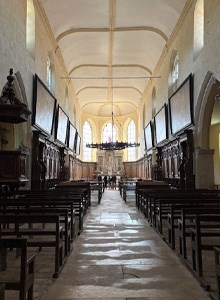
Hautvillers is a idyllic Champagne village that looks like it is from another time. Owing to Dom P, it is the busiest in the region, but we were still able to get into every growers’ place for a drink. It isn’t very big so I’d recommend walking as many of the small sloping streets as you can to make decisions on which growers you plan to visit before finding the Église Saint-Sindulphe on the outskirts and paying your respects to the master. The church isn’t anything particularly special, but it is charming and well worth doing whilst you are there.
Not far from the church is a fantastic viewpoint giving you sweeping views over the Marne Valley, overlooking the crus of Cumieres and Damery a bit further on. There are some giant deck chairs to sit on and take it all in, and it is also a great spot for a picnic. Follow the road looping round the church grounds to another viewpoint, the Belvédère de Dom Pérignon to admire the rows of vines a little more, until cutting back in and continuing around the church ground walls back towards Hautvillers. This brings you right up to an official Dom Perignon Champagne building, although we couldn’t go inside so I can’t tell you what it was. Still, a good chance to get a picture next to the Dom signs in Hautvillers itself.
Hautvillers – Grower Champagne Tastings
Champagne Fedyk
The first stop was a place called Champagne Fedyk, a quaint old courtyard complete with flint bricked barn and house. You can actually stay there and enjoy their swimming pool with panoramic views over the vineyards. As a Champagne maker, they are more recent to the game, with their grandfather setting things up in the late 20th century, now managed by his grandchildren. They are authentic, terroir-driven and gave me a real sense of envy happening to have property in the region. That said, Champagne making is no easy matter particularly for smaller producers!
The prices were extremely agreeable compared with places we had been so far, with the most expensive, their rose Saignee being only 8 euros. Despite expecting most things to be cheaper here because you are at source, you’d be mistaken for the big names. Anyway, back to Fedyk.
I had a glass of their Blanc de Blancs, my wife the Rose de Saignee. The BdB is a pure Chardonnay expression, with zippy citrus and white flowers giving a great sense of terroir. The Rose was on the opposite scale with 100% Pinot Noir – it was a deep cherry pink, with a supple and fresh palate, crisp fruitiness, minerality and length. Plenty of red fruit flavour.
Champagne G. Tribaut
Following back through to the town centre then onto the Rue de Bacchus, you will find a larger grower, G. Tribaut. Before going in, admire their little vineyard across the road and grape press in their working winery, all in the courtyard. They are a distinguished family-run producer established in 1935 by Gaston Tribaut, and now in its fourth generation, led by Vincent, Valérie, and rising star Gauthier. With just 12-13 hectares of vineyards, they make some stellar wines.
They make pretty much every type of Champagne from Demi-sec to vintage Blanc de Blancs and even a Ratafia. I was cruelly limited to just three by my wife opting for their Blanc de Noirs, Demi Sec and Vintage. The Blanc de Noirs was robust yet fresh with candied fruit and a pleasing richness. The Demi Sec was filled with yellow plum and peach, alongside caramelised notes and dried fruit. And of course a very pleasing sweetness. The Vintage was a chardonnay dominant blend showcasing maturity and freshness in equal measure, combining yellow fruits and hazelnut with lively, zippy citrus.
You might think that was enough for one day. Yes, we did return back to Epernay to relax, but that was in aid of giving us some time to digest in preparation for our wine tasting dinner at Perrier Jouet! I won’t go on about it, but suffice to say you really have to at least go to their bar on the Avenue de Champagne and try a few. It is by far one of the best looking bars in the whole region. It’s up to you if you make a fancy evening of it too.